
Optical Fibers
(for Optogenetic Experiments)
Product Description


The Thomas RECORDING optical fibers are intended to be used for optogenetics, delivering light (from lasers/LEDs) into specific brain regions to control genetically-modified neurons (opsins) for studying neural circuits. Our optical fibers have a unique selling point in the conical fiber tip, which results in minimized tissue damage when the fiber is inserted into the brain. Thomas RECORDING optical fibers are made for chronic or acute optogenetic experiments in living animals. They can be implanted permanently or inserted for the duration of a single session. Furthermore these fiber are used for in-vitro applications like in lab settings to control neural activity in cell cultures or brain slices. Our optical fibers can be combined with microelectrodes or microelectrode arrays (fixed or moveable) for simultaneous stimulation and recording, enabling detailed studies of neural circuits.
Fiber Tip Shapes
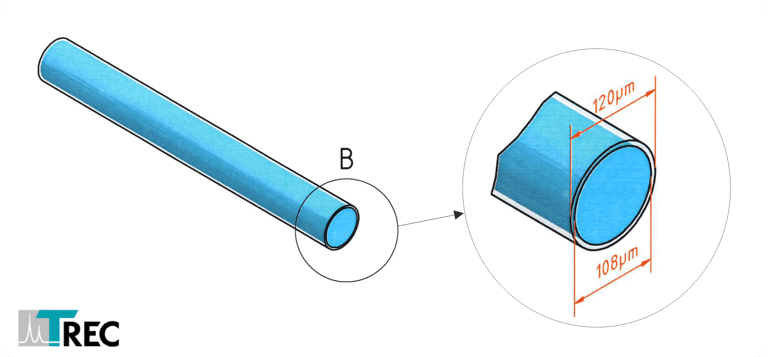
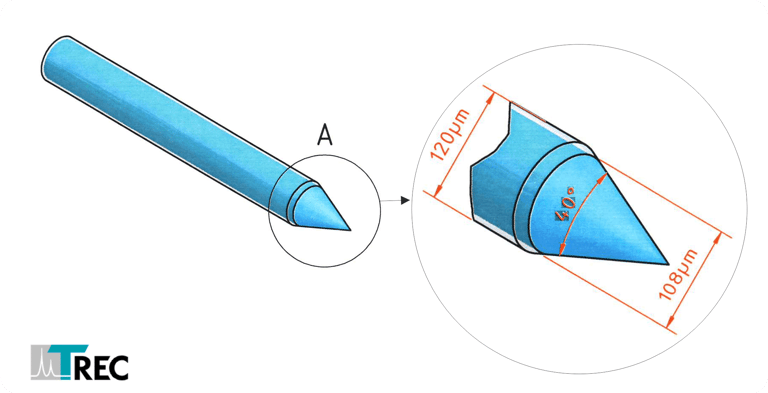
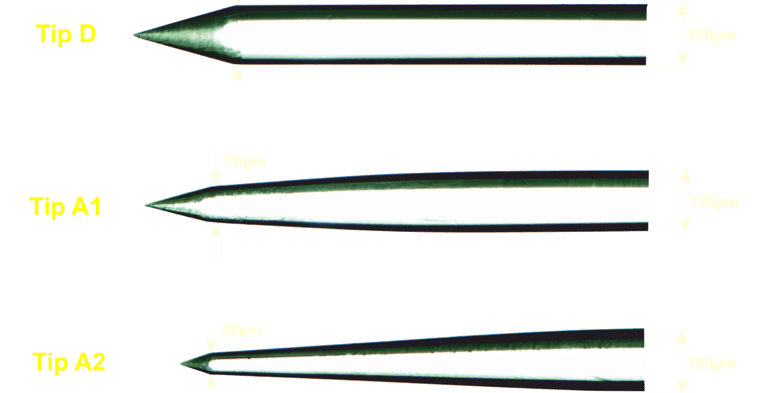
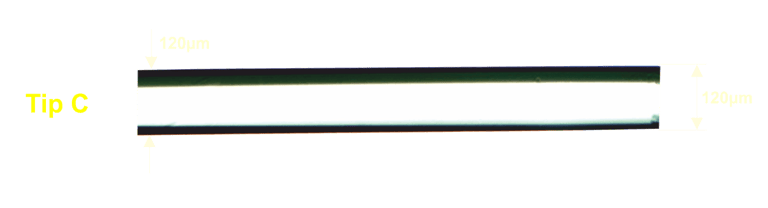
Thomas RECORDING optical glass fibers are available with different tip shapes as shown in the following pictures. Tip shape C is a blunt fiber tip, tip shape D is ground and polished and tip shapes A1 udn A2 are pulled, ground and polished.
Optical Fiber Tip Light Distribution
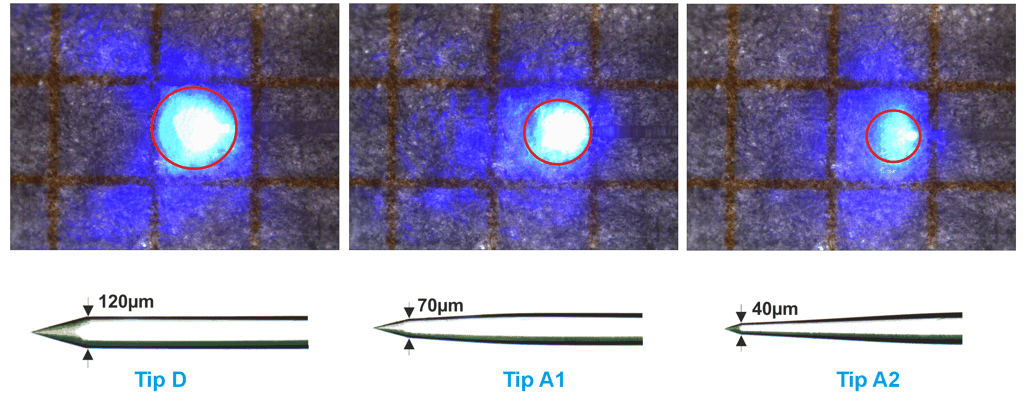
This picture shows the light distribution of three different TREC optical fiber conical tip shapes. As can be seen in the picture above, the diameter of the globular light distribution around the optical fiber tip decreases as the tip diameter decreases. We can therefore adapt our optical fibers to the size of the brain nuclei to be illuminated by pulling and grinding the tips of our optical fibers.
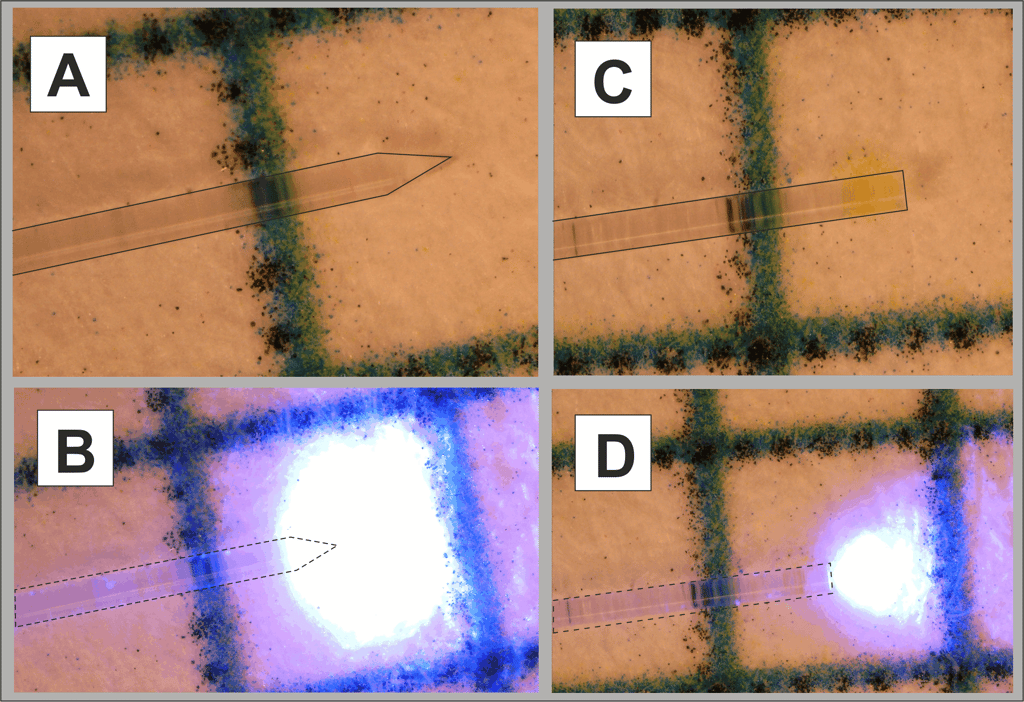
This picture shows [A] shows an optical fiber with tip shape D (conical tip) with the LED light source switched OFF, [B] same fiber with LED light source swithed ON. [C] shows an optical fiber with tip shape C (blunt tip) with the LED light source switched OFF, [D] same fiber with LED light source swithed ON. As can be seen in the picture above, that [B] optical fibert tip D shows a globular light distribution around the optical fiber tip and [D] tip shape C (blunt fiber) shows a smaller, more forward-facing beam of light.
Ordering Information
Optical Fiber
Optrode
Optetrode
Product Brochure
Selected Publications
[1] Lima, S.Q.; Hromádka, T.; Znamenskiy, P.; Zador, A.M.;
PINP: A new method of tagging neuronal populations for identification during in vivo electrophysiological recording;
PLos ONE, July 2009, Vol 4, Issue 7
[2] J. A. Pochapski, J. Franke, W. Kruse, R. Jacob, S. Herlitze, C. Da Cunha, R. K. W. Schwarting, L. Melo-Thomas
Optogenetic stimulation of inferior colliculus neurons elicits mesencephalic locomotor region activity and reverses haloperidol-induced catalepsy in rats
Sci Rep. 2025 Apr 12;15(1):12649. doi: 10.1038/s41598-025-96995-4.
[3] J. Hüer, P. Saxena, S. Treue
Pathway-selective optogenetics reveals the functional anatomy of top–down attentional modulation in the macaque visual cortex
Proceedings of the National Academy of Sciences 121 (3), e2304511121
Request Information
Location
Winchester Strasse 8
35394 Giessen, GERMANY
Hours
Mo.-Fr. 8:00 a.m - 4:00 p.m.
Central European Time (CET)
Sa. - Su. Closed
info@ThomasRECORDING.com